Why SMART Safety Objectives Matter (And How to Write Ones That Actually Move the Needle)
May 13, 2026



Aviation is widely recognized as a high-reliability industry. Over decades, we have developed, tested, and refined operational practices that manage complexity, reduce error, and protect margins of safety in unforgiving environments. Many of those practices—Crew Resource Management, checklists, threat and error management, stabilized approach criteria—have since been adopted by other high-risk industries.
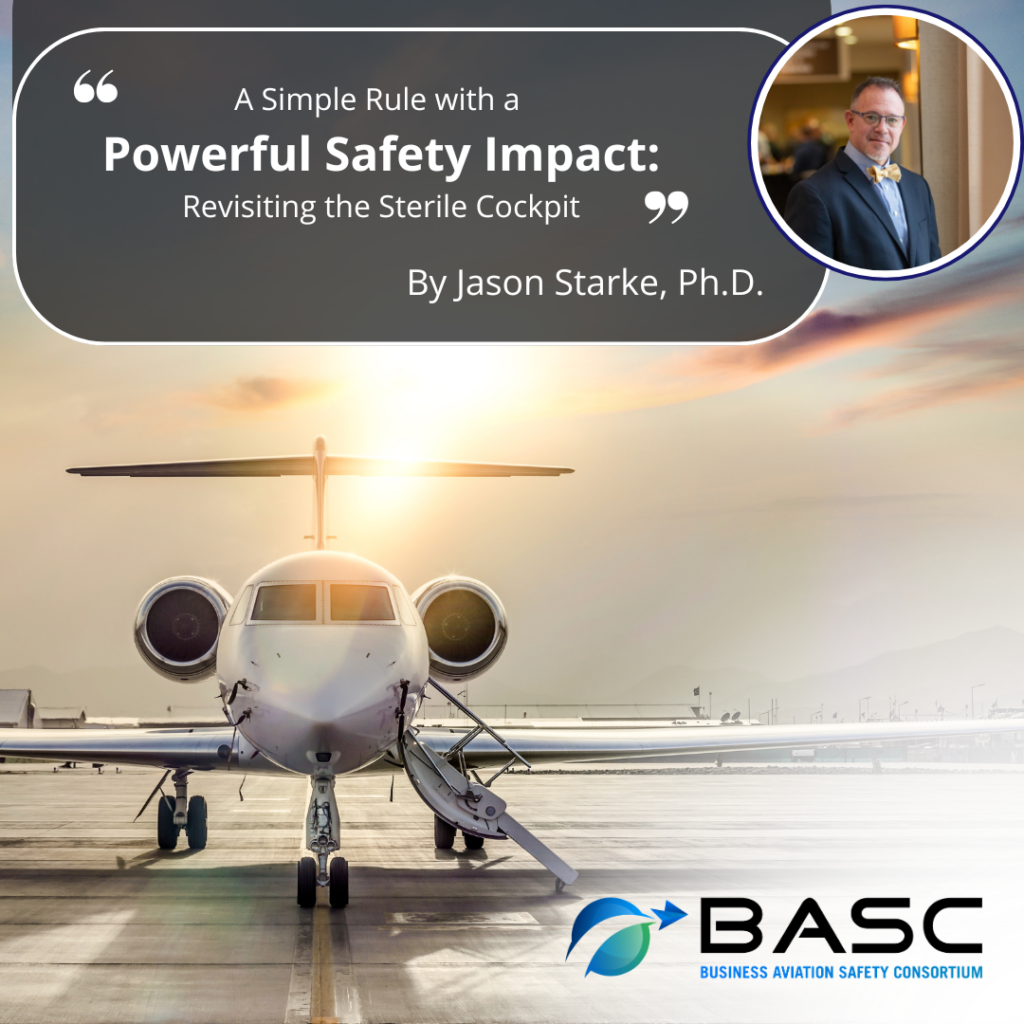
One of the most familiar of these practices is the sterile cockpit rule.
For most of us, this concept is ingrained early in training and reinforced throughout our careers. It is typically codified in operations manuals as a prohibition on unnecessary conversation and nonessential device usage below 10,000 feet—or during other critical phases of flight. We all know the language. We all brief it. And, candidly, we have all seen it drift from strict adherence, often as complacency creeps in during routine operations.
History reminds us that this drift matters. Several high-profile accidents have demonstrated how seemingly benign distractions during critical phases of flight can cascade into serious outcomes. What can feel like a simplistic rule is, in fact, a deliberate control against cognitive overload, divided attention, and missed cues at moments when precision matters most.
Interestingly, recent research outside aviation reinforces just how powerful this “simple” rule really is.
Lessons from Medicine: Sterile Cockpit on Hospital Ward Rounds
A recent medical study examined the application of the sterile cockpit concept during hospital ward rounds—an environment that, like aviation, is dynamic, interruption-prone, and safety-critical. In this study, clinical teams adopted sterile cockpit principles: minimizing interruptions, limiting parallel conversations, clarifying roles, and ensuring focused communication during patient evaluations.
The results were telling.
When compared to a control group, teams using sterile cockpit principles significantly improved the accuracy of major documentation elements, increasing from 63.6% to 77.9%. This improvement was statistically significant.
In this context, major documentation errors were defined as omissions or inaccuracies involving critical patient information—such as diagnosis, treatment plans, medication changes, or escalation decisions—items that, if misunderstood or missed, could directly affect patient outcomes. In other words, these were not clerical errors; they were safety-relevant failures.
Beyond documentation accuracy, the study also found that patients cared for by teams practicing sterile cockpit principles reported higher satisfaction and were more thoroughly attended to by physicians. Importantly, these gains were achieved without increasing the time spent per patient, underscoring that improved focus—not added workload—was the key factor.
Aviation’s Leadership—And Our Ongoing Responsibility
This research reinforces something aviation has long understood: focused communication during critical tasks matters. The sterile cockpit is not about rigidity or silence for its own sake—it is about creating a cognitive environment where attention is protected, priorities are clear, and errors are less likely to slip through unnoticed.
Aviation has led the way in exporting safety concepts to other industries, and the sterile cockpit is a prime example. Seeing it validated in healthcare—an entirely different operational context—should prompt us to reflect inward as well.
So the next time you brief or enter the sterile cockpit, resist the temptation to treat it as procedural background noise. Remember that this seemingly simple rule carries disproportionate safety value. Its effectiveness has been proven not only in aviation, but now in other high-risk domains where lives also depend on getting it right.
Sometimes, the most powerful safety tools are the ones we already have—if we choose to use them as intended.