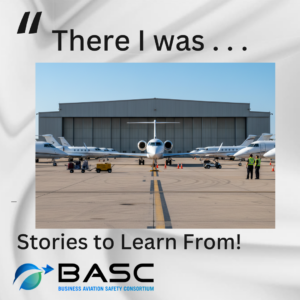
On November 19th, I was taxiing our Gulfstream G-600 onto the FBO ramp at [airport identification removed]. The time was approximately 10 o’clock in the morning, and the ramp was densely populated with parked aircraft.
A line service person operating a golf cart directed us to follow him toward our assigned parking location. As we proceeded, we maneuvered through the congested ramp without wing walker support. My first officer and I continuously monitored our respective wingtips, maintaining a very slow taxi speed.
Forward of our position, I identified a line service technician positioned in front of a hangar, employing standard aircraft marshalling hand signals. His professional appearance and crisp uniform suggested proper training and competence. His position indicated he was directing us to park close to the hangar structure to reduce our footprint on the active ramp. I observed cones and chocks had been placed in the area.
As I began the right turn toward the parking position, I confirmed my left wingtip cleared a vehicle parked near the hangar. At this juncture, a second marshaller became visible, stationed immediately adjacent to the hangar doors—a position that provided excellent visibility for monitoring wingtip clearance. Based on their positioning and signaling, I concluded these personnel possessed the necessary experience and capability.
This second marshaller signaled a right turn, momentarily adjusted to indicate straight movement, then resumed the right turn signal—apparently making small adjustments to optimize our final position. I complied with his direction. Control was then transferred back to the original marshaller, who had repositioned himself outside my right cockpit window, and he continued signaling the right turn.
A vibration transmitted through the aircraft structure.
I initially attributed this to the nose wheel responding to the tight steering input. As I completed the turn and aligned the aircraft in the parking spot, I recognized the vibration might have indicated contact with the hangar. Exiting the aircraft, I confirmed damage to our winglet. The marshaller who had positioned himself near the hangar doors was visibly distraught and apologized profusely, acknowledging he had miscalculated our clearance. He clearly felt very badly about the incident.
Throughout this entire sequence, no marshaller signaled us to halt or indicated we were approaching an unsafe proximity to the hangar structure.
Lessons Learned:
1. Complex ground operations require wing walkers. Operating on a congested ramp with limited clearances and no wing walker support created an unacceptable risk condition. I should have required wing walkers prior to continuing the taxi.
2. Uncertainty requires immediate action. Any doubt regarding clearances mandates stopping the aircraft and setting the parking brake until the situation is clarified. Operational momentum is not an acceptable justification for accepting risk.
3. Trust operational instinct. When the situation appears tight or constrained, that perception should heighten caution rather than increase dependence on external sources.
4. Account for wing growth during turns. During tight turns, the outer wing travels through a significantly larger arc than may be apparent from the cockpit. The wingtip radius extends well beyond what pilots can easily judge from their seated position, particularly in close-quarter maneuvering situations. This “wing growth” effect must be factored into all clearance calculations, especially when operating near fixed obstacles.
Additional Note:
I subsequently learned that the line service technician who was directing us during the wingtip strike was terminated. This represents a missed opportunity for organizational learning. Simply removing the individual involved—essentially firing the problem away—fails to address the underlying systemic factors that may have contributed to this event. A comprehensive investigation should have examined the context surrounding this incident: What was the technician thinking? What pressures or circumstances influenced their decision-making? What training, procedures, or operational constraints were in place? Effective safety culture requires examining both horizontal factors across the organization and vertical factors within the chain of command, not merely focusing on individual performance. Without this broader analysis, we cannot determine whether systemic failures exist that could lead to similar incidents in the future. True learning organizations use these events to improve systems, not simply to assign blame.