Why SMART Safety Objectives Matter (And How to Write Ones That Actually Move the Needle)
May 13, 2026


At BASC, we say that we walk with organizations toward organizational excellence. If you’ve heard us say that, you might have wondered — why don’t we just say we help organizations become safer? After all, isn’t safety the point?
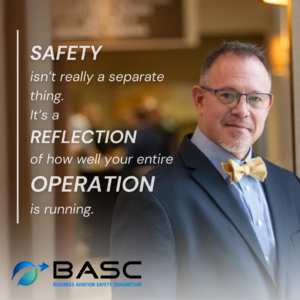
It’s a fair question. And the answer gets at something the research has been telling us for a long time: safety isn’t really a separate thing. It’s a reflection of how well your entire operation is running.
When the Department of Energy examined safety culture across its organizations, the conclusion was straightforward: safety culture is not a separate function but an integrated part of organizational culture (DOE/EFCOG, 2015). You can’t meaningfully separate it from the culture of your day-to-day operations because everything is connected. Bisbey et al. (2021) reinforced this in their synthesis of safety culture models, finding that safety culture is shaped by the same multilevel organizational forces — leadership, identity, and social learning — that shape organizational culture as a whole. It’s not something you build alongside your culture. It is your culture. Roughton and Crutchfield (2011) said it even more directly: a lack of safety performance is a symptom of failure in an organization’s management system — not a failure of the safety department.
Think about that in the context of a corporate flight department. When something goes wrong — a maintenance discrepancy that gets missed, a flight that launches without proper planning, a crew member who doesn’t speak up about a concern — it’s almost never just one person making one bad decision. It’s usually a combination of system-level factors working together. Maybe leadership isn’t visible or engaged. Maybe there’s no real trust between the crew and management. Maybe training has become a checkbox exercise instead of something that actually builds competence. Maybe the operation has grown but the processes haven’t kept up.
That’s what organizational excellence is really about. The research defines it as the sustained condition where an organization’s leadership, culture, strategy, processes, and people are all aligned and working toward consistently strong outcomes (Bou-Llusar et al., 2009; Lasrado, 2018). It’s not about being perfect in one area. It’s about the whole system functioning well together. The major excellence frameworks — EFQM in Europe, Baldrige here in the U.S., the Shingo Model — all agree on this point: you can’t achieve excellence by optimizing one piece while ignoring the rest. Peters and Waterman (1982), in their landmark study of high-performing companies, found that the common thread wasn’t better procedures or bigger budgets. It was culture — a bias for action, closeness to the people doing the work, leaders who were visible and value-driven.
Cameron and his colleagues (2004) took this further. They found that organizations demonstrating virtuousness — things like integrity, trust, compassion, and genuine care for people — actually outperformed others financially. Not just in morale. In hard business results. It turns out that when people trust their leaders and feel genuinely valued, they do better work. They pay more attention. They speak up. They take ownership.
This idea isn’t new. It goes back to the ancient Greek concept of eudaimonia — often translated as human flourishing. Aristotle argued that when people live and work in conditions that allow them to do their best, excellence isn’t something you have to force. It becomes the natural outcome. In an organizational context, eudaimonia means creating an environment where people have purpose, where they grow, and where they genuinely care about the work and each other (Ryff et al., 2023). When those conditions exist in a flight department, you don’t have to convince people to work safely. They already want to — because excellence is just how the place operates.
And here’s where it connects back to your flight department.
An organization that is truly excellent — where leadership is engaged, where people trust each other, where processes work and learning actually happens — that organization doesn’t need a separate safety program bolted on. Safety emerges naturally from how it operates. The crews plan well because the culture demands it. The mechanics speak up because they trust that it matters. The leadership stays engaged because they understand that their visibility and involvement is what holds it all together.
This is exactly why, when BASC comes to visit your operation, we’re not there to inspect you. We’re not walking in with a checklist to catch what’s wrong. We’re looking at your department as a system — how your leadership, culture, processes, training, and people work together as a whole. Are they aligned? Are they supporting each other? Is the system producing the outcomes you want — not just in safety, but across your entire operation? Because if the system is healthy, safety takes care of itself. And if it’s not, no amount of individual compliance will fix what’s really going on underneath.
That’s what walking toward organizational excellence means. It means looking at the whole picture — not just the pieces — and helping you build an operation where doing things well is simply how your team works every day.
References
Bisbey, T. M., Kilcullen, M. P., Thomas, E. J., Ottosen, M. J., Tsao, K., & Salas, E. (2021). Safety culture: An integration of existing models and a framework for understanding its development. Human Factors, 63(1), 88–110.
Bou-Llusar, J. C., Escrig-Tena, A. B., Roca-Puig, V., & Beltrán-Martín, I. (2009). An empirical assessment of the EFQM Excellence Model: Evaluation as a TQM framework relative to the MBNQA Model. Journal of Operations Management, 27(1), 1–22.
Cameron, K. S., Bright, D., & Caza, A. (2004). Exploring the relationships between organizational virtuousness and performance. American Behavioral Scientist, 47(6), 766–790.
DOE/EFCOG. (2015). A guide to safety culture evaluation. U.S. Department of Energy.
Lasrado, F. (2018). Achieving organizational excellence. Springer.
Peters, T. J., & Waterman, R. H. (1982). In search of excellence: Lessons from America’s best-run companies. Harper & Row.
Roughton, J., & Crutchfield, N. (2011). Ten elements of safety excellence: An integrated organizational approach. International Risk Management Institute.
Ryff, C. D., Boylan, J. M., & Kirsch, J. A. (2023). Meaningful work, well-being, and health: Enacting a eudaimonic vision. International Journal of Environmental Research and Public Health, 20(16), 6570.
Discover how BASC can help your team guard the interface effectively.
Fill out the form to request a consultation and discover the benefits BASC can offer to your organization.