The Tools Aren’t the Problem
October 5, 2026


By Jason R. Starke, Ph.D.
In business aviation, some of the most significant risks don’t originate within a flight department — they emerge at the interfaces between organizations. Whether it’s an aircraft maintenance vendor, a catering company, or most notably, a Fixed Base Operator (FBO), the point where two systems meet is often where the potential for damage or injury increases the most.
While the FAA lightly addresses this in 14 CFR Part 5 (mainly the notification of hazards to interfacing organizations), true interface management goes far beyond notification. It’s about understanding how risk migrates across organizational boundaries and building defenses to stop it before it becomes an event.
And while interface management isn’t explicitly included in ICAO Annex 19, it is well-defined in ICAO Document 9859, 4th Edition (Safety Management Manual). There, ICAO outlines how risks can migrate between organizations and stresses the importance of managing those boundaries effectively — especially where two safety systems interact.

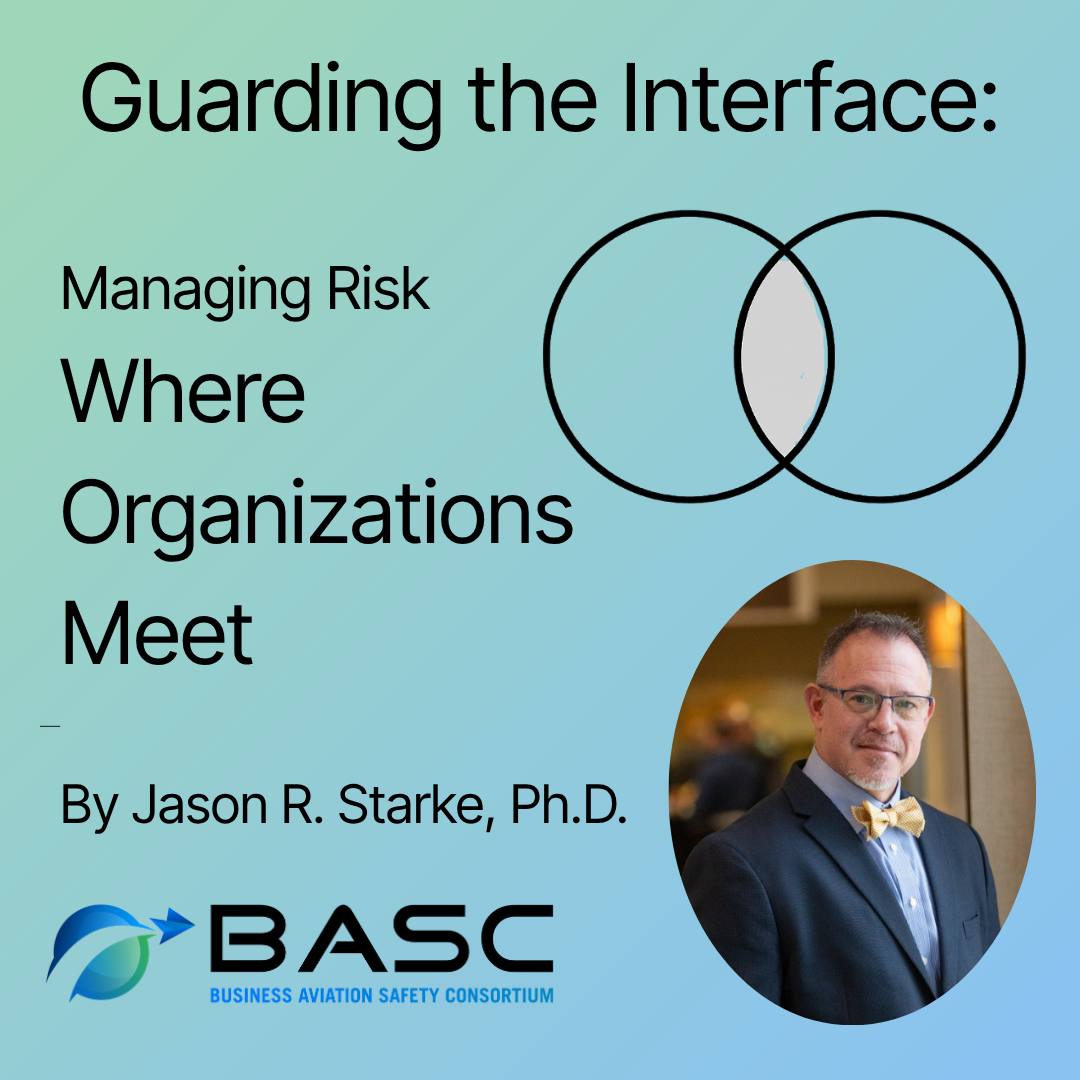
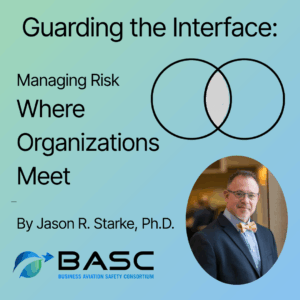
Figure: The shaded overlap represents the interface — where risk can migrate between organizations.
Imagine two overlapping circles — one representing your organization, and the other representing a service provider like an FBO. The area where the circles overlap is the interface, the shared operational space where hazards can move from one system to another. The goal is simple but vital: protect the overlap.
From the FBO side, strong internal defenses are ideal: standardized procedures, trained personnel, and consistent safety practices. Programs like IS-BAH and NATA Safety 1st are designed to prevent small lapses from turning into big problems.
But not every FBO has these defenses, and even the best can degrade over time. That’s when the flight department must reinforce its circle.
✅ Be present during fueling, towing, and servicing
✅ Ensure adequate wing-walkers and communication
✅ Review fuel quality control logs and ask about testing
✅ Confirm procedures align with your own safety expectations
These actions aren’t intrusive — they’re smart, collaborative, and protective. They keep small risks from migrating across that interface boundary.
Every operation has its own unique interface points — those special, risky overlaps where systems meet and where risk can leak across the boundary. As part of your ongoing SMS evaluation, identify these interfaces and ask:
• Where does my organization depend on another group to maintain safety?
• What defenses exist on their side?
• And what defenses must we maintain on ours?
• If those defenses are not in place — or are in a weakened state — what temporary or procedural mitigations can we employ until they are restored?
A particularly critical example is the interface between flight operations and maintenance — especially third-party maintenance facilities. This interface carries inherent risk because operational control and physical custody of the aircraft are shared across organizational boundaries.
But that’s just one example. BASC flight departments should take a deliberate look across their systems and identify all other interfaces where risk can migrate — such as between flight operations and scheduling, with vendors providing ground handling or deicing, or with external training providers. Each of these shared boundaries deserves attention, defined communication pathways, and visible defenses to ensure risks don’t cross unnoticed.
At the end of the day, interface management isn’t about blame or ownership — it’s about stewardship. Each organization has a duty to protect not only its own people, assets, and reputation, but also those of its partners and service providers.
The best operators understand that safety isn’t confined by organizational boundaries — it’s shared. When both sides maintain their defenses through communication, professionalism, and mutual respect, risk decreases and trust grows. That’s where true safety excellence lives