By Jason Starke, Ph.D
Every Friday, I dive into the latest research on organizational performance, safety, and leadership—scouring both the web and Google Scholar for insights that can make me a better BASC Facilitator and Auditor. Yes, I know, total nerd move. But staying current with safety and organizational excellence research isn’t just academic curiosity; it’s essential for helping organizations build real resilience.
This week, I stumbled across something that stopped me in my tracks: an excerpt from David Woods’ work on resilience engineering. Woods, a professor at The Ohio State University, has spent years studying how organizations bounce back from the unexpected. In Essentials of Resilience, Revisited, he breaks down what makes systems truly resilient, covering everything from adaptability to brittleness to the critical trade-offs organizations face.
But it was his discussion of initiative that really grabbed me.
The Power of Initiative
Woods defines initiative as three interconnected capabilities:
- The ability to adapt when the original plan no longer fits reality
- The willingness to modify planned activities to work around obstacles
- The capacity to begin adapting independently, using whatever information and knowledge is available in the moment
Reading this, I immediately thought of a time-tested decision-making framework that embodies these exact principles: the OODA Loop.
Enter the OODA Loop
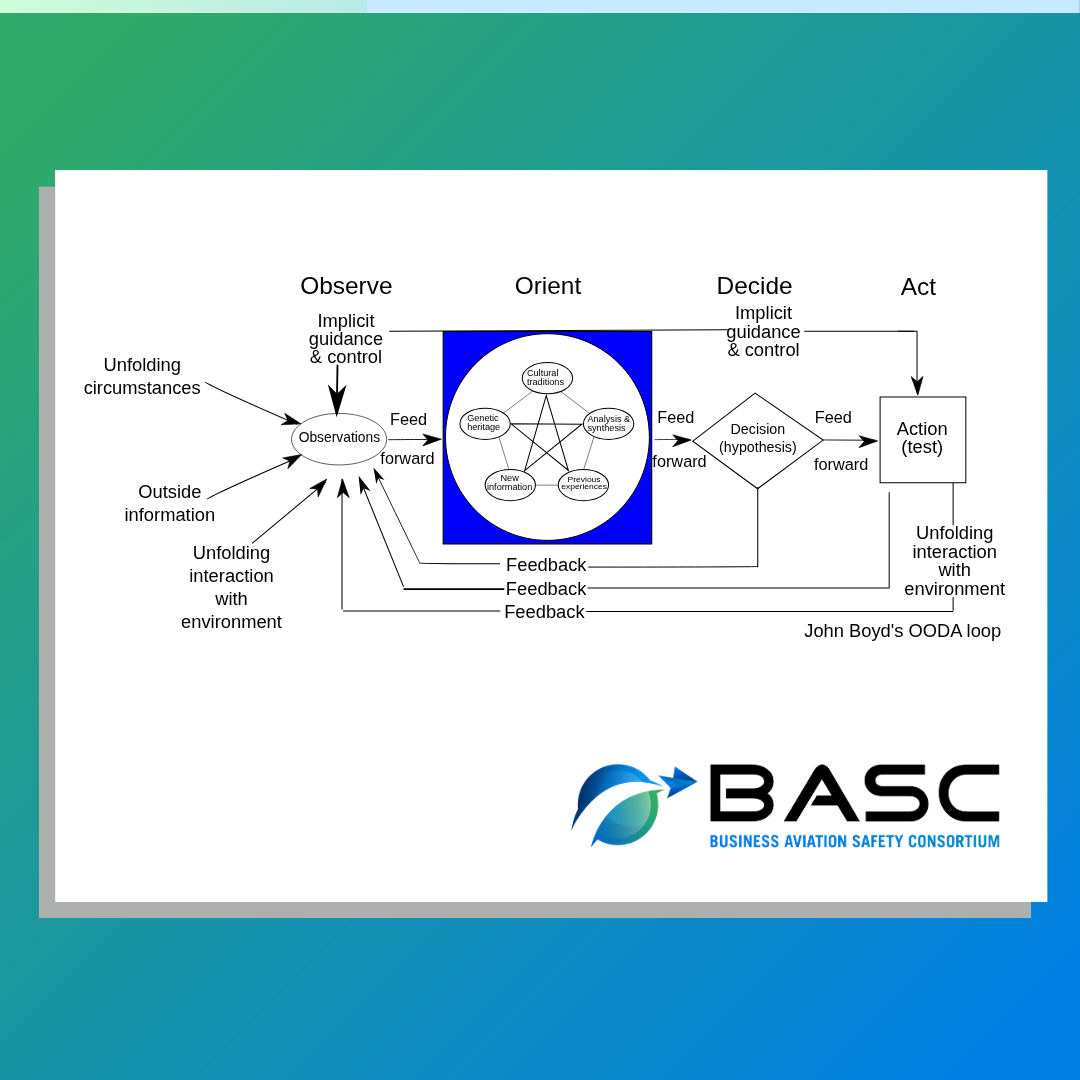
The OODA Loop was developed by USAF Colonel John Boyd during the Vietnam War era, and it remains one of the most effective tools for navigating complex systems where conditions change rapidly. Unlike complicated systems (which have many moving parts but generally produce predictable outcomes), complex systems like aviation are characterized by interactions that don’t always yield predictable results.The OODA Loop—Observe, Orient, Decide, Act—provides a structured approach to making decisions when uncertainty reigns:
Observe: Develop situational awareness by viewing and understanding the current situation and how it’s evolving. In aviation, we call this “maintaining situational awareness (SA),” and it’s foundational to everything we do.
Orient: Cut through the noise to understand how the environment has actually changed. This isn’t just data collection—it’s logical assessment of what the new reality means for your mission.
Decide: When there’s a mismatch between expectations and reality, this is where Woods’ concept of initiative kicks in. You must choose a course of action even when the original plan no longer applies.
Act: Execute your decision with commitment, understanding that in complex systems, your first attempt may not achieve the desired result.
Why the Loop Matters
The cyclical nature of OODA is crucial. As H. William Dettmer points out in Systems Thinking: And Other Dangerous Habits, complex systems rarely respond as expected on the first try.
Success often requires multiple iterations, with each cycle of OODA helping you close the gap between what you planned and what’s actually happening.
Bringing It Home
As aviation professionals, we operate in an inherently complex environment where conditions shift without warning and the gap between plan and reality can open in seconds. The OODA Loop isn’t just theoretical—it’s a practical framework that empowers crews to exercise the kind of initiative Woods describes.
This concept deserves a place in our safety training and standup discussions. When we give our people a clear decision-making paradigm like OODA, we’re not just teaching them to handle variations in our environment—we’re building the organizational resilience that keeps us all safe when things don’t go according to plan.
Because in aviation, as in life, the plan is just the starting point.